Sparse Grid Combination Technique with Time Stepping
The sparse grid combination technique (Griebel et al. 1992, Garcke 2013, Harding 2016) can be used to alleviate the curse of dimensionality encountered in high-dimensional problems. Such problems are encountered as partial differential equations (PDEs) in many fields of science and engineering. Instead of using your PDE solver on a single structured full grid (where every dimension is finely resolved), you would use it on many different structured full grids (each of them differently resolved). We call these coarsely-resolved grids component grids. Taken together, all component grids form a sparse grid approximation, which can be explicitly obtained by a linear superposition of the individual grid functions, with the so-called combination coefficients.
The component grids can be identified with their level vector \(\vec{\ell} \in \mathbb{N}^d\) whose length equals the dimensionality \(d\) of the problem. From it, one can derive the grid’s spacing \(\vec{h}\) as \(\vec{h} = \frac{1}{2^{\ell}}\), assuming the domain is \([0,1)^d\).
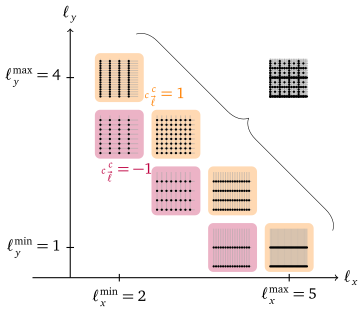
Figure originally published in (Pollinger 2024, adapted from Pollinger et al. 2023).
For instance, a the \(x\)-direction level of 5 denotes a the grid spacing in the \(x\) dimension of \(h_x = \frac{1}{32}\). Assuming periodicity, this means we use 32 points in dimension \(x\), like illustrated by the rightmost component grid in the above figure.
Here, we use the truncated combination technique, which sets a minimum and maximum level, \(\vec{\ell^\text{min}}\) and \(\vec{\ell^\text{max}}\), to select the component grids \(\vec{\ell} \in \mathcal{I}\). The set of all selected component grids \(\mathcal{I}\) is referred to as the “combination scheme”. For regularity, we assume a constant difference between \(\vec{\ell^\text{min}}\) and \(\vec{\ell^\text{max}}\) in each dimension, but other schemes can be useful.
One can then compute suitable combination coefficients \(c_{\vec{\ell}}^c\) that are used to obtain a sparse grid function \(f_\text{SG}\) by way of a linear superposition of functions \(f_{\vec{\ell}}\) defined on the component grid:
\(f_\text{SG} = \sum_{\vec{\ell} \in \mathcal{I}} c_{\vec{\ell}}^c\cdot f_{\vec{\ell}}\)
In the two-dimensional combination scheme in the above figure, all combination coefficients are 1 and -1, respectively. The sparse grid is illustrated on the upper right.
This sparse grid function can be expected to be accurate in \(\mathcal{O}(h^2 \cdot \log(h^{d-1}))\), given some assumptions on the bounds of mixed-dimension partial derivatives, where \(N\) is the number of points corresponding to the finest resolution occurring in the scheme. At the same time, the number of points is only \(\mathcal{O}(d\cdot N(\log N)^{d-1})\), drastically less than the \(\mathcal{O}(N^d)\) needed for a finely-resolved full grid. Thus, while the gains in accuracy per degrees of freedom are the most prominent for high dimensionalities (\(d \geq 4\)), even two-dimensional schemes can benefit significantly for fine resolutions.
Between time steps, the grids exchange data through an intermediate multi-scale represenation, which is summarized as the “combination” step in DisCoTec. Assuming a certain smoothness in the solution, this allows for a good approximation of the finely-resolved function, while achieving drastic reductions in compute and memory requirements.